Search this blog

Showing posts with label BioDiversity. Show all posts

Blissful summer days.. & we've converted a horse trailer to a bathroom!

View from our bath

This summer we have had the utter joy of having a bathroom! It's luxury and I can't believe we've done without one for so long.
We got our horse trailer and bath from Ebay, the water (immersion tank) is Leo's mum's old one, complete with lagging and Leo made the woodburner from an old & large 47kilo gas bottle. Very satisfying.. Leo will be writing up how he made the woodburner soon hopefully!

We've not got round to decorating yet.. too busy having baths!

It takes under 2 hours to heat up the water, which is about 120ltrs and one burner load of wood. We use the water for bathing, laundry and washing up. I can't quite express how much better it makes us feel, psychologically it's like a weight's been lifted.

Toilet Tit

This wee fledgling and her buddy live in our compost loo every night. The first I noticed her was when she made a deposit on my foot while I was making my own, erm, deposit...


Dora

Dear friends, I'd like you to meet the new love of my life, Dora. She is a Dutch Bantam chicken who was rescued, covered in blood, underweight and weak, by my pal Luisa. Dora has an horrific injury on the back of her neck, as you can see below...
Dora's injury is healing very well

I don't know what it is about chickens but their spirit and their innocent adventuring always melts my heart, that and the fact it ony takes a few gentle strokes, purring sounds and some apple to get them to trust the big smelly oafs that us humans are.

Dora and her new best friends, Bubbles (in front) and Heidi (in back)

I could cry with joy at the sight of this. Dora and her new perch pals off out exploring, adventuring and bringing destruction to many red soldier beetles in the meadow.

My office
 Above is my makeshift office (bizarrely minus a stool in this picture!). I'm so lucky I can sit outside to work, I do a lot of office based stuff for the Save Our Woods campaign that would drive me batty if I had to sit in the yurt to do. Phew :)

A male Golden ringed dragonfly resting on a hazel

Our river meadow, coppice and woodland edge is a magical place to be at the moment. Full of butterflies, roe and red deer, dragonflies, adders, passing otters, too many species of bird for me to list here and lots and lots of wildflowers...

Silverwashed fritillary

Leo and I went butterfly hunting the other day and spent an hour or so surrounded by crazy Silverwashed fritillary's. They've done so well this year, much better than our Small pearl bordered fritillary's. I still find it exciting to watch the Silverwashed fritillary's in flight, they fly so strongly and of course are very territorial so everynow and again you get a brilliant fight kick off!

Silverwashed fritillary feeding on bramble

Something I hadn't noticed before I saw these photos was the raised strip on each wing. If you look at the first picture of the fritillary above you can see that there is what looks like a lighter coloured short strip on each wing, in the photo above you can see that those strips are raised. Wonder if that's aeronautical design?! Anyone know?


Thank you to the lovely Ceri for introducing me to the world of the hammock and snorkeling. The hammock forces me to relax and snorkeling, well, what can I say about snorkeling? It's other wordly and a magical experience. Here's a youtube video from a couple of random strangers that are snorkeling where Ceri took me snorkeling... blissful!


hen xx

A short vid of a Female Violet Oil Beetle eating a Celandine flower


Learn more about the Oil beetle family at BUGLIFE.ORG.UK

It is a female Violet Oil Beetle in the video, she has a swollen abdomen as she has just emerged to find a male and is full of eggs. If you look carefully you'll see little flies on her body, they're feeding on the oil she exudes. When she's mated she digs a nest and lays her fertilised eggs, up to a thousand of them!

When those eggs hatch the larvae set about finding a solitary bee by climbing into a flower and waiting. When the bee arrives to feed on the flower the larvae hop on to it's back and get a lift to the bees nest. In the bees nest the larvae pupate and begin to feed on the bees eggs and food stores. Quickly growing and pupating again. They stay in the bees burrow until emerging in the spring the following year as adults like the female in the video.

An amazing life cycle!


hen xx

Scrub land and Natural Regeneration - weaving a path, finding treasures

I'm re-blogging this blog post from back in July 2012 after reading my friend Sarah's brilliantly researched article on scrubland.

Hello there..

The 4.5 acre slope we were going to flatten to the ground and plant with trees is now an area of scrubland, heathland and natural regeneration. This was a HUGE decision for me to make. I LOVE planting trees and always thought it was better to plant trees, than not. However, I have learned a thing... sometimes it's better not to plant trees. It's true, honest! I won't be able to explain our thinking fully in this post but hopefully I can give you a wee insight in my thinking...

Firstly, here's a link to a blog showing me clearing some of this area with a slasher and then a pedestrian tractor rough cutter. This was in our first year at Stockwood and I had taken advice from the local Exmoor authority, the Forestry Commission and the Woodland Trust before doing anything. All were very keen for me to crack on and flatten the lot, plant it up with trees, put a massive red deer fence up around the whole area and manage the new trees with glyphosate.

It's worth mentioning here that the Forestry Commission made the point to me that if we can afford to, we should use a local tree nursery using native seed stock grown-on in this country. I had to refuse the 1500 free trees that the Woodland Trust gave me because they were coming from Holland. I refused them because I was concerned over the health of the tree stock, the embedded energy in transportation and the likely use of fertilizers and chemicals to propagate and grow on the trees.  At the time I didn't know about the threat from tree diseases from trees imported from abroad, I was worrying about the weakness of the trees causing them to catch a disease after I planted them.  Thank goodness I did refuse those trees from the Woodland Trust or I would have been planting ash trees infected with Chalara Fraxinea. Goodness knows where those trees destined for my scheme on Exmoor ended up.

Ok, on with the story of why I didn't flatten this area and why I cancelled the tree planting scheme


Refusing the trees from the Woodland Trust made something click in me, I began to realise that in my excitement I hadn't really thought this through. I was basing my decision to clear this scrubland and plant all of these trees based on what I had always wanted to do and what I was being encouraged to do by organisations I trusted.  I now realise that these organisations are focused on single issues and have targets to reach every year. This isn't a criticism, they're just doing what they believe in, it's my responsibility to take their advice and then go away and get a wider perspective.  

The one thing I wasn't doing was listening to the land. Doing just that is how I got my wider perspective!  It's the tiny little Grasshopper Warbler we have to thank for finalising my decision to maintain this area as scrub and heath land. It kept me awake at night for weeks with the crazy-loud cricket noise it makes because it chose to nest in the area of scrubland close to our yurt. The RSPB have given it Red Status, so I chose not to destroy it's habitat.

It was at this stage that whenever I had a visitor to the land I would take them for an explore around the scrubland and after a while I would ask them how they'd feel if I grubbed it all to the ground, fenced it from the red deer and planted it up with trees. My friend Karen, who is as mad about trees, woodlands and forests as me, looked at me horrified and said 'Don't do it. Please, don't do it'.  Every one of the people I asked had supported the idea of the tree planting scheme BEFORE they actually met and listened to the scrubland. After meeting and listening to the scrubland not one person thought I should go ahead with the scrub clearance and tree planting scheme.

I'm in my 4th year of observing this area now and it has taught me just how much LIFE there is in scrub. Adders, newts, slow worms, badgers, foxes, red deer, roe deer, bugs, spiders, beetles, loads of butterflies including the heath, pearl bordered and (on the edges) the Silverwash Fritillary, moths, bees and fabulous looking hoverflies & flies, goodness knows how many wild flowers and approximately a million visiting & nesting birds (including Cuckoo, Red Wing, Red Start, Woodcock, Grasshopper warbler, Dartford Warbler, Stonechat, Whinchat, Black cap, Longtailed Tit.. etc, etc...).

The Gorse and Birch are doing a great job of being nursery plants and there are now areas around the edges of the scrub full of young trees like; Hazel, Hawthorn, Oak, Rowan poking out the middle of a dense Birch thicket or an old Gorse shrub about to split to do the great tree reveal! As you head up the scrubland it has more of a heathland feel, with large patches of heather, purple moor grass and other grasses and wildflowers, lichens and mosses all spilling out of the ancient stone bank with a mixed hedge on top. An incredible mosaic of habitat!  There is even an ancient badger sett that has been meticulously kept clear of any scrub and is a perfect circle of grass, wildflowers and the odd clump of bramble. The relationship between the badgers and red deer are evident here, with the badgers creating many paths between their network of tunnel entrances and flat areas from their excavations, which the deer find a suitable place for resting in cover and feasting on the lovely grass.

This year I am picking my way through the undergrowth like Mayweed out of Duncton Wood, snouting out the best pathways and finding so many treasures it's hard to contain myself. Here are some I have found today. It was late and the light low but the adventure was great!


hen xx

A Permaculture Allotment - From weeds to rich food growing habitat in 4 months!

This article was first published in Permaculture Magazine in 2004. I nurtured this allotment for 4yrs before buying land in Exmoor. I go on about the land on this blog. I now run my own no-dig market garden in South Devon with my best friend Elliott, and with a LOT of help from my kind partner Leo. Have a peek at our gardens and veg here - www.spindlebrook.co.uk

We didn't stop believing our dream of buying & nurturing a piece of land could come true & worked hard to get here.  If I could give one bit of advice.. don't EVER give up on your dream.


All of the photographs can be viewed huge if you click on them :)


Love at First Site

My Newbury Allotment Site

When I spent some time WWOOF-ing at Lowershaw Farm in 1993, they introduced me to Permaculture. It was immediately clear to me that this was the future. I spent several years in the wilderness and it took me until September last year (2003) to finally get back on track when I decided to get an allotment & enrol on Patrick Whitefield’s Permaculture design course at Ragman’s Lane Farm.

What an experience that was! I went on to study for the full diploma, which consisted of a 5 week Sustainable Land Use course, followed by several written assignments.

Above is a picture of the allotment I was given on a miserable, damp and cold late Feb. morning. On first glance it looked like the only thing going for it was the water trough at the southwest end. I was left staring at a huge 10 pole plot.

With every drip of my nose my enthusiasm was draining away...

There were hybrid berry suckers knee high in places near the far end, mixed in with the hardcore pernicious perennials. You know the ones, couch grass, Dock, Nettles, Creeping Thistle and buttercup & beautiful teasel towering above my head. It was like an undulating hillside in miniature. None of it was flat.

I desperately wanted to see what the general state of the soil was. So I took my spade and dug a few test pits sporadically over the plot. The results weren’t good. It was very stony, heavy soil and 60cm down it was large aggregate. After doing the spit and roll test I decided that I had a sandy clay loam.


Permaculture Flower

It was time to do the observation bit of the Permaculture design process. Not just using my eyes, but using all my senses, feeling for wind direction, variations in temperature, soil depths, shade, etc. I walked slowly around the plot, stopping from time to time. Taking in the vibe of where I stood, seeing what indicator plants there were around my feet, taking notes and drawing a basic base map. This might sound lovely, but the wind blew a stinging rain onto my cheek, the temperature was freezing, I kept falling into holes and, well, when it came to shade, I just couldn’t tell!

Should I have stopped? Probably, but I couldn’t, it was very exciting. Finally, after all this time of rented accommodation and no garden, I had my own little piece of Earth. Somewhere to carefully grow healthy food imbued with love, somewhere to hang out, whittle things, plant my Willow and most importantly, somewhere to learn how to heal soil.

At one end of the plot is a path with a ditch and two Oak trees both probably well over 120 yrs old and 40’ high. This cheered me up no end, as I’ve got a thing about trees and to have Oaks, well, that’s the ultimate! However, I knew that meant that I couldn’t be growing veg’ down there. It would have to be where my Zone 5 was, the wildlife zone. There was already Bluebells 3 inches high, Pulmonaria and Celandine down there. It could be the perfect spot for… oh pants; it’s not the time for planning! It is so hard to resist designing the entire area before even getting home, having a cup of tea and taking stock.

So I went home, made a cup of tea, defrosted and got my soggy base map out. For the next 3 weeks I would communicate via grunts and nods only looking up from my A3 pad and colouring pencils to go to the loo. It was design time.

I thought it would be a good plan to make a list of all the fruit and veg’ I love, and what I’d need to grow them. It was a very, very long list. So, after much thought I called my friendly council-man and rented the 10 pole plot next door. I was expanding before I’d even dug a bed. My partner was slightly concerned but thought it best not to interfere at this stage, as I was mildly obsessed.


Finally, after 8 (ish) drafts, I had my design. Fortunately I was in-between jobs and so was able to spend entire days at the allotments. Arriving at 8am and getting home well after 6. It seemed to provide lots of amusement to my fellow allotmenteers, seeing a ‘girl’ trying to dig out couch grass in the wind and sleet, muttering about her plans to build a pond, put up a greenhouse and plant Willow.


Willow bed planted late Feb 2004

Same willow bed 4 months later! Thats comfrey in the foreground.

The Permaculture Herb Spiral


Wildlife pond

After a month, my partner Leo and I had managed to plant 90 Willow trees, build a wildlife pond and herb spiral, dig the couch and perennial weeds out of most of the beds, source a shed for £40 and a huge wooden framed greenhouse for £25 (both 2nd hand from the local free ads). Everything else, even the pond liner, was reclaimed from friends & family.


2nd hand greenhouse & shed. Potato hot bed in foreground.

Meanwhile, back at the house, I had decided that in order for me to catch up with the growing season I would get a couple of those three tiered plastic greenhouses to germinate the seeds in. They worked fantastically, and now provided much needed shelving space, without their covers, in the greenhouse & shed.

Phew! It was certainly hectic and I wouldn’t have been able to do it if I had to do a ‘proper’ job at the same time.


The Beds


Beetroot, carrot, fennel, poached egg plant, basil, nasturtium, marigold


Half of one of the plots was put aside to be cleared of weeds long-term, using black sheet mulch in preparation for apple trees in the autumn. I wanted to use the space immediately though to increase my annual yield. My new allotment buddy Burt had given me some Pumpkin seeds he’d saved, so I used this area to grow them along with some Butternut squash. To prepare I dug ten holes (about ½ m in diameter), loosened the subsoil and mixed some well-rotted manure with the topsoil. After covering the area, including the holes, with two sheets of mulch (pegged down with home made wire staples) I cut little crosses over the prepared holes planted the pumpkin and squash through the cuts, and watered thoroughly.

Squashes & pumpkins

Although slow growing to start with, the sheet mulch was completely covered for most of the growing season and we had masses of fruits. So, even though it was an area being cleared using a long-term technique I was still able to get an incredible amount of food from it at the same time.


Raised strawberry bed interplanted with onions.

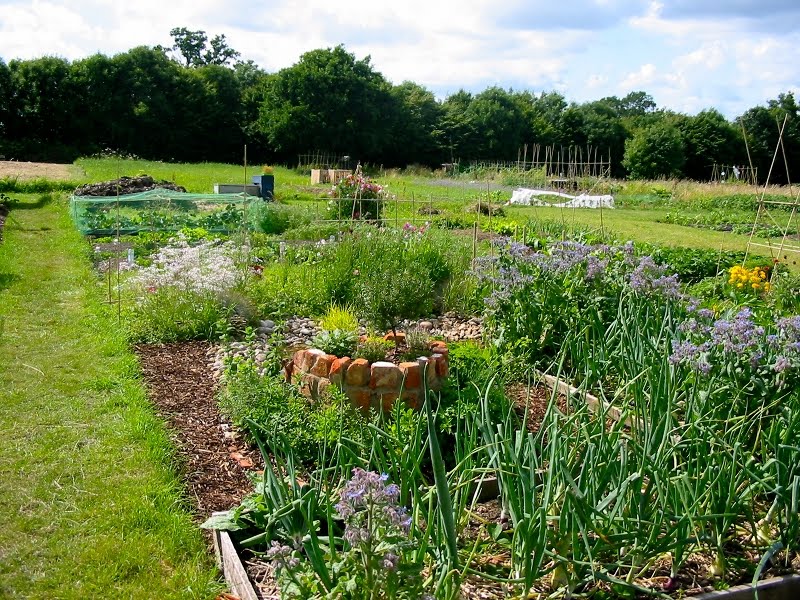
The planting scheme I used was based on a simple 8 yr rotation with each species planted in small raised beds arranged in equidistant blocks. I surrounded each bed with crimson clover, phacelia, buckwheat or tagetes. This helped to keep the sides of the raised beds together and also provided an undisturbed labyrinth of corridors around the beds for wildlife. When July came, the change in the plots was awesome. Everything I had sown had grown.

Plants grow!

I decided on raised beds because of the soil depth/quality issues. They were created by removing the couch, loosening the subsoil, carving out 40cm paths either side and putting the unturned soil on top of the bed. Each of the beds is 1m wide, and as yet have not been permanently edged, (the materials haven’t made themselves available yet).

The best compost bins in the world ever.


Rainwater Collection

Reclaimed, professionally cleaned IBC collecting from the greenhouse & the shed.


The plan was for us to locate a large water butt between the shed and the greenhouse in order to collect rainwater from both roofs at a single point. Lucky for us we were given a professionally reclaimed bulk container.

It would have been used for storing liquid chemicals, but now it’s being used to store up to 1000 litres of water. The container is raised up on reclaimed concrete blocks and is a perfect vertical space for some climbers next year.


The Open Day


In July we had an open day at the allotment site. There were so many people on my plot that I hid behind the shed. But, I soon got found out and had a queue of people asking questions and wanting a tour. It was wonderful. They loved the diversity of flowers and veg all happily growing together. They were inspired by the pond and habitats. More than once I heard an excited adult singing out and pointing at the Dragonfly and it’s mate ‘doing the business’ and laying.


Wildlife pond (aged 3months) FULL of newts, dragonflies & everything else!

Some people were scribbling down old varieties and names of green manures, talking excitedly about where they could grow them in their gardens or allotments. The comment most repeated was that it reminded them “of their Grand parents garden”. Butterflies, Ladybirds, Dragon, Damsel and Hover flies, bumble and honey bees, the place sang with busyness. They said it felt alive. This was the most wonderful compliment. Not that it was my compliment to accept; it was nature that inspired them, not me. The truth is that there was a concentration of nature in one place, where no one expected it to be.


Borage is a wonderful thing!


I made a welcome sign for the main entrance to the plots, which bore the date of when we first started – March 2004. Not one person could believe it, they had forgotten things want to grow. If you make space for plants they fill it, only too happily if it's the right place.


Many people were interested in ideas on how to supress weeds, pests and diseases without using chemicals. Which was easy to explain because I could just show them living examples.

Some of the guy’s that have been on the site for over 25 years, following the same routines, have told me that after seeing how my plots have developed, they will re-think how they grow their crops from now on. Mixing their veg planting with some flowers, creating some wood piles, putting up wildlife boxes, reducing (and in some cases stopping) pesticide & herbicide use. They weren’t sure at first, but they’re sure now. That’s got to be a result!


There's a hedgehog box in that pile of oak twigs!


And so to Bed


We are in the process now of putting the soil to bed – mulching for the winter, planting a hedge and some apple trees, and building wildlife habitats. I’m going to plant some more Willow too, as a windbreak on the South West corner, as that’s where the worst of the wind comes from.


After spending so much time with the plots over the past 10 months I can work in a more harmonious way, and understand their needs, and mine, much better.

It’s not appropriate for everyone to do their growing on this scale to start with. “The best size of veg plot for an inexperienced person is 3x3m” – Patrick Whitefield. Which is great because the average garden nowadays isn’t much bigger than that. The area I grow veg in works out at about 10mx4m (not including the paths in between). The rest is there for wildlife, fruit and playing with.

I’ve always moved around, living in rented accommodation, never putting down any roots. Even now I don’t know where I’ll be next year. I realised that my desire to grow things went beyond just producing food. It’s the soil, wildlife, everything that needs to be nurtured, even if it is just for a year or a few months. We can positively impact the little bit of Earth under our feet, regardless of whether or not we’re there to benefit from it. So, if you are anything like I was and are waiting till you’ve got your own bit of land, my advice is - don’t, live like there’s no tomorrow and get out there and grow your leeks in a bucket if you have to.


hen xx
Related Posts with Thumbnails