Search this blog

Showing posts with label Plants. Show all posts

Scrub land and Natural Regeneration - weaving a path, finding treasures

I'm re-blogging this blog post from back in July 2012 after reading my friend Sarah's brilliantly researched article on scrubland.

Hello there..

The 4.5 acre slope we were going to flatten to the ground and plant with trees is now an area of scrubland, heathland and natural regeneration. This was a HUGE decision for me to make. I LOVE planting trees and always thought it was better to plant trees, than not. However, I have learned a thing... sometimes it's better not to plant trees. It's true, honest! I won't be able to explain our thinking fully in this post but hopefully I can give you a wee insight in my thinking...

Firstly, here's a link to a blog showing me clearing some of this area with a slasher and then a pedestrian tractor rough cutter. This was in our first year at Stockwood and I had taken advice from the local Exmoor authority, the Forestry Commission and the Woodland Trust before doing anything. All were very keen for me to crack on and flatten the lot, plant it up with trees, put a massive red deer fence up around the whole area and manage the new trees with glyphosate.

It's worth mentioning here that the Forestry Commission made the point to me that if we can afford to, we should use a local tree nursery using native seed stock grown-on in this country. I had to refuse the 1500 free trees that the Woodland Trust gave me because they were coming from Holland. I refused them because I was concerned over the health of the tree stock, the embedded energy in transportation and the likely use of fertilizers and chemicals to propagate and grow on the trees.  At the time I didn't know about the threat from tree diseases from trees imported from abroad, I was worrying about the weakness of the trees causing them to catch a disease after I planted them.  Thank goodness I did refuse those trees from the Woodland Trust or I would have been planting ash trees infected with Chalara Fraxinea. Goodness knows where those trees destined for my scheme on Exmoor ended up.

Ok, on with the story of why I didn't flatten this area and why I cancelled the tree planting scheme


Refusing the trees from the Woodland Trust made something click in me, I began to realise that in my excitement I hadn't really thought this through. I was basing my decision to clear this scrubland and plant all of these trees based on what I had always wanted to do and what I was being encouraged to do by organisations I trusted.  I now realise that these organisations are focused on single issues and have targets to reach every year. This isn't a criticism, they're just doing what they believe in, it's my responsibility to take their advice and then go away and get a wider perspective.  

The one thing I wasn't doing was listening to the land. Doing just that is how I got my wider perspective!  It's the tiny little Grasshopper Warbler we have to thank for finalising my decision to maintain this area as scrub and heath land. It kept me awake at night for weeks with the crazy-loud cricket noise it makes because it chose to nest in the area of scrubland close to our yurt. The RSPB have given it Red Status, so I chose not to destroy it's habitat.

It was at this stage that whenever I had a visitor to the land I would take them for an explore around the scrubland and after a while I would ask them how they'd feel if I grubbed it all to the ground, fenced it from the red deer and planted it up with trees. My friend Karen, who is as mad about trees, woodlands and forests as me, looked at me horrified and said 'Don't do it. Please, don't do it'.  Every one of the people I asked had supported the idea of the tree planting scheme BEFORE they actually met and listened to the scrubland. After meeting and listening to the scrubland not one person thought I should go ahead with the scrub clearance and tree planting scheme.

I'm in my 4th year of observing this area now and it has taught me just how much LIFE there is in scrub. Adders, newts, slow worms, badgers, foxes, red deer, roe deer, bugs, spiders, beetles, loads of butterflies including the heath, pearl bordered and (on the edges) the Silverwash Fritillary, moths, bees and fabulous looking hoverflies & flies, goodness knows how many wild flowers and approximately a million visiting & nesting birds (including Cuckoo, Red Wing, Red Start, Woodcock, Grasshopper warbler, Dartford Warbler, Stonechat, Whinchat, Black cap, Longtailed Tit.. etc, etc...).

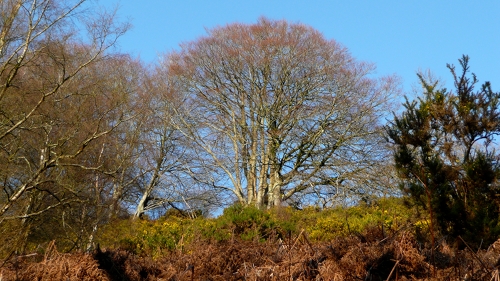
The Gorse and Birch are doing a great job of being nursery plants and there are now areas around the edges of the scrub full of young trees like; Hazel, Hawthorn, Oak, Rowan poking out the middle of a dense Birch thicket or an old Gorse shrub about to split to do the great tree reveal! As you head up the scrubland it has more of a heathland feel, with large patches of heather, purple moor grass and other grasses and wildflowers, lichens and mosses all spilling out of the ancient stone bank with a mixed hedge on top. An incredible mosaic of habitat!  There is even an ancient badger sett that has been meticulously kept clear of any scrub and is a perfect circle of grass, wildflowers and the odd clump of bramble. The relationship between the badgers and red deer are evident here, with the badgers creating many paths between their network of tunnel entrances and flat areas from their excavations, which the deer find a suitable place for resting in cover and feasting on the lovely grass.

This year I am picking my way through the undergrowth like Mayweed out of Duncton Wood, snouting out the best pathways and finding so many treasures it's hard to contain myself. Here are some I have found today. It was late and the light low but the adventure was great!


hen xx

Spring Equinox on Exmoor and How to tap a Birch tree!


It's been a glorious Spring so far! I wrote a wee poem on Facebook earlier to celebrate the Spring Equinox...


Dear Spring, 
I love you very much. 
So much you make my heart leap and my belly flutter. 
I love you so much I spend weeks searching for you and then weeks watching you emerge, stretching out of your buds, leaves unfolding like a dragonfly's wings. 
Spring, when I wake up I grin at the feel of you. That unmistakeable energy you bring as the sap shoots up the tree and nests and dens are filled with the sound of the young. 
I love you for having the greatest soundtrack of all. Birds singing, bees humming and woodpeckers keeping the beat...
Dear Spring, I love you!

...It's been a tough winter ;)


I went for an explore of the wall at the top of one of our regeneration areas. I found many wonderful things. Like this Apple Moss... (thanks to David Spain for ID help!)


Lots of pennyworts, nettles and whispers of ferns too and many scuttles and shadows. 
I'm still blown away by the amount of work that's gone into building these hedge banks, miles of them! 


This beech tree is a really old hedge bank tree. It's girth at the base is 5 hen hugs. Which makes it.. erm... oh, it's just very old indeed.


This is the first bud burst of 2012 for me! Wonderful, gorgeous Hazel! This one is on the track, so it's really sheltered. I reckon it's another week yet before any of the other's start bursting properly. Can't wait!


One of my favourite wee flowers, the female flower of the Hazel. It's the colour I love and the joy at trying to spot them in the tree is one of my Spring treats, they're so tiny!


The farm is covered in barren strawberry. Absolutely beautiful but incredible disappointing for me... no strawberries... gah! 


I present to you, my wonderful beans, the Bluebell... throughout the coppice there are more and more bluebells appearing! In some areas there's a carpet of them. It's such a wonderful change and has taken 4 years to start to come back. The issue before, I think, was heavy grazing and erosion on the slopes. 


This is the leaves of Common Valerian. A beautiful plant that flowers later in the year. This is also growing in ever greater numbers in the single area that it lives, at the end of the river meadow on the edge of the coppice.


One of my favourite plants at this time of year is the opposite-leaved golden saxifrage. There's carpets of it down in the valley. 


It's an incredible sight at the moment!


The photograph above is of a mix of wild plants.  This is how I learned to identify some wildflowers by their young leaves, before they flower. Not including the grass, I can name 4 plants in this photo. How many can you name?! : ) 


Birch Tapping

Today I did some Birch tapping. The sap is just right and was flowing freely! Here's how I did it..

What you need: 
  • An old water bottle, sterilised (I soaked it in a light bleach solution for a few hours).
  • Thick string (I use old baler twine)
  • A strong, sharp, CLEAN, knife. (I used my Chris Grant knife)
  • Bit of solid wood about as thick as your arm, for a mallet. (I used a seasoned length of hazel I found near the Birch tree) 
  • A green twig as thick as your pinky finger. (I cut a fresh hazel twig)


How to tap a Birch tree:
  • Choose a Birch tree that looks strong and healthy, with no visible fungi & with buds that look ever so slightly 'awake' or swollen. The girth of the tree should be over 25cm. I like to make my incision on a clean bit of bark (not knobbly).
  • Taking the middle of your length of twine, make a clove hitch, slip it on to the neck of the bottle and tighten. Tie the twine around the tree, securely.
  • STOP


Now you need to make your peg:
  • Collect a fresh, green twig from a nearby tree, that's as thick as your pinky finger. Here I used a Hazel twig.
  • Carefully, cut the twig to size, about inch or so is normally ok and scrape off the bark. This will give you a good clean bit of wood. 
  • Carefully cut both ends to a slope (in basketry we call it slyping). Make one end flatter than the other, this will be the end that goes into your incision. The flatter end of my peg is on the right of the picture below.
  • Carefully cut yourself a small channel in the middle of the peg.


Making your incision:

  • Use your peg to check where you need to make the incision, remembering that about quarter of an inch will be inside the tree. Obviously the peg shouldn't over shoot the top of the bottle!
  • Angle your knife upwards, with the blade horizontal. (see the pic below)
  • Using your sturdy bit of wood, firmly and in a controlled manner (!) thwack the end of your knife, TWICE. The TIP of your knife should be in the tree up to about 1/4 inch.
  • Give the knife a small wiggle, you do not want to break the bark. You should see a bit of sap gather on the knife.
  • Remove the knife.


Putting in your peg:
  • Gently put the flat end of your peg into the incision. You don't need to shove it in, just put it in a few millimetres till you see the sap start to run down it into your bottle. Make sure it's not going to fall out.


Notes:
  • Birch sap is clear. If your sap is yellowy discard it. 
  • You can let your tap run for as long as you have bottles to catch it in. It will only stay fresh for a few days once collected and it's not recommended you drink too much as it can give you a bad belly.
  • Don't tap this tree for another three years. (Is dependent on how much you take & how big your incision..)
  • You can make all sorts of things with it. A syrup, wine, tea, cordial... I tend to drink it straight or make a cup of nettle tea with it & some honey. Quite a powerful energy boost for me that tea!


MOST IMPORTANT OF ALL:

You must show the tree gratitude for the gorgeous elixir you've just taken by making sure the wound is clean, small and will heal quickly. A small slit like this will pose no threat to the tree as long as you follow those small steps. When I'm finished collecting the sap I press down on the slit for a little while and it slows the flow of the sap and finally stops altogether.

Let me know how you get on! 


hen xx

Planting an Olive tree in a pot and that sort of thing...


As a big thank you to my mum and step dad for letting me stay with them for the past few months I made them this little pot. Mind you, the pot was theirs! I just filled it! Normally I wouldn't do this sort of thing as I prefer to only use native plants or plants that have been pinched out of a long established garden. However, this is what I decided I wanted to do for them.

The little rockery under the tree is Poppy, Aubretia, cyclamen, sempervivum, and one whos name I can't for the life of me remember!

Poppy


Aubretia


I just don't remember!


I also wanted to share with you how I'm using my new basket creations...


Melons and onions, I know, it's weird.
Related Posts with Thumbnails